Wednesday, July 20, 2011

World's 10 Funniest Museums

By Bibek Sengupta |  Published in Anandamela, ABP Publications, Kolkata 5th July 2011


Anandamela 5th July edition published my article 'World's 10 Funniest Museums' as cover story. Also, got the rare opportunity to design and illustrate the cover for the iconic children's magazine of Kolkata.

Tuesday, January 04, 2011

World Cup Football 'FIRSTS'

By Bibek Sengupta
Published in ANANDAMELA on June 05, 2010, An ABP Publication, Kolkata

Saturday, November 14, 2009

Advertising - Through the Years

by Bibek Sengupta

No one who has caught a big fish will walk home through the back alley. The cave man surely didn’t. The cave man was just blowing his own trumpet but ingenious men around got the idea. Advertising soon came about.

Textbooks say, advertising today, is a form of communication that typically attempts to persuade customers to purchase or to consume more of a particular brand of product or service. The average man on the street however understands things differently. Say it with flowers. Say it with pictures. Whatever be it, just say it. Or else how will you convince people that you are good. This is precisely the advertising.

The Origins
Egyptians used papyrus to make sales messages and wall posters. Commercial messages and campaign displays have been found in Europe and ancient Arabia. Rock painting for commercial advertising is another manifestation of an ancient advertising form, which is still present in many parts of Asia, Africa, and South America .
As education spread and well printing developed, advertising expanded to include handbills. In the 17th century advertisements started to appear in weekly newspapers in England. These early print advertisements were used mainly to promote books and newspapers.

Philadelphia – Where It All Started
It was Pennsylvania Gazette, published by Benjamin Franklin from Philadelphia in 1729 with a page full of advertisements.

But the road ahead was not smooth in the beginning. Many publications banned advertisements while others limited the space to one column width. However by 1870 there were over 5,000 newspapers in circulation which carried advertisements and the demand for advertising services grew rapidly.

The Strategy of Early Advertising
In June 1836, French newspaper La Presse introduced paid advertising allowing it to lower its price, extend its readership to increase its profitability. And suddenly people realized that advertising paid.

The strategy of early advertising was to convince the buyer of the quality of the product. A realistic illustration of the product, numerous descriptions praising its virtues from prominent citizens were commonly used. Later product claims gave way to elaborate stories of purchases that rewarded the buyer with success or popularity.

Early Advertising Agencies in Philadelphia Volney B. Palmer opened the first advertising agency in Philadelphia in 1841 and is possibly the first person to use the term "Advertising Agency."

N. W. Ayers & Son. In 1869, 21 year old Francis Wayland Ayer opened a firm named after his father, N. W. Ayer. The firm was so successful that by 1877 it acquired the remains of the original Volney Palmer agency and therefore claimed to be the ‘oldest advertising firm in the USA’.

They created some of the most enduring slogans in advertising history, including: "When it rains it pours", advertising salt for Morton Salt. "A diamond is forever", advertising diamonds for De Beers, "Reach out and touch someone", advertising AT&T’s long-distance telephone services. N. W. Ayer shifted to New York City in 1973 and existed till 2002.

Some Interesting facts:
  • The turning point in the history of advertising came in the year 1450 when Johann Gutenberg invented the printing press. Advertising no longer had to produce extra copies of a sign by hand.
  • Lord and Taylor (1867) is the first company to use double-column advertising in newspapers.
  • John Wanamaker (1879), department store owner, places the first whole-page newspaper advertisement. He had after all a whole department to advertise.
  • John E. Powers (1880), who becomes known for his advertising honesty and direct advertising style. Powers becomes known as "the father of honest advertising."
  • The Graphic Design, as we know it today originated in the late 19th century as a tool for advertising. William Addison Dwiggins, who first used the term "Graphic Designer" described the importance of typography in advertising design.
  • Branding begins in 1904. Children were now not happy with just a candy or a bar of chocolate. They wanted a Cadbury or a Nestle.
  • The first annual advertising show opens in New York City in 1906 . The "Age of Advertising" officially begins.

The Advertising Firsts in India
Right from the days when cities and markets first sprang up in India , hawkers had been calling out their wares. We just didn’t realize they were “advertising”. They then graduated to advertising in the papers and distributing handbills . However, advertising proper began in India with classified advertising in the 18th century. Printed advertisements appeared for the first time in weekly newspaper Hickey's Bengal Gazette. B.Dattaram & Co in Bombay , formed in 1905 claims to be the oldest existing Indian agency. ‘Dalda’ was the first major example of a brand and a marketing campaign specifically conceived for Indian consumers developed in 1939.

----------------------
Source: History of Advertising and Publishing By Lisa Marie Heitman , Wikipedia, Advertising- The Mother of Graphic Design by Stephen Heller
Acknowledgement : Thanks to Yasmin Ali for her valuable inputs.
Cartoons: Bibek Sengupta

Thursday, August 13, 2009

World's First 'ROCK' Band!!

By Bibek Sengupta   |  Published in Unishkuri, 19th July 2009, an ABP Publication.

There’s no more ‘rock’ to ‘rock music’ than just the word. Legend has that this type of rock music was inspired by the sounds made by a river running over a special kind of rock. Bibek Sengupta takes a look at how man improvised on nature’s sounds to create a unique genre of music.


By the River Greta
Nature resides in all her glory at Cumbria county, in northwest England. Keswick is a quaint little village here. The Greta flows past this village, at the foothills of the Skiddaw and brushing Lake Coniston.

It was a languid summer afternoon in 1785. Retired sailor Peter Crosthwaite was stirred by an unusual tune that hung in the air. He often heard this tune when he strolled by the river. It was not a musical tune, but rather like someone playing the organ and rustling up varied tunes. Crosthwaite’s curious eyes wandered to a boulder on the river. It was an unusual rock, found only in this part of Lake District in Cumbria. The tunes were created when the river water splashed on this rock.

Crosthwaite was not a scientist by training, but he had a penchant for making innovative things from various odds and ends. He scoured the river and brought home about fifteen or sixteen of these rocks. He tinkered with them, examined them closely and came up with sixteen different kinds of tunes. And before he knew it, he had made the world’s first geological piano or a ‘rock organ’. He never knew that 55 years after his discovery of this magical rock, Joseph Richardson’s almost identical musical contraption would create ripples across the world.

The Richardson Set
A mason by profession, Richardson too hailed from the village of Keswick. He was also intrigued by the sounds that came out from the rock on the Greta. He had noticed that the same kinds of sounds emanated from a type of Paleozoic rock, ‘Hornfels’ found at the foothills of the Skiddaw. What is more, the quality and the variety of these sounds were greater.

Richardson was excited with his findings and what he could create from this rock soon became an obsession. He built stone houses and so he was well-versed with the properties and characteristics of various rocks. He worked to earn his livelihood by the day and at night, he tinkered with all kinds of rocks and pebbles. His efforts bore fruit after 13 long years and he created a massive ‘rock harmonicon’. It was a musical instrument with five octaves and he had used 65 rocks of various sizes in two rows. He named this the ‘Richardson Set’. It was a humongous instrument and three people were required to play it.

The First Band
Richardson was musically inclined himself. He could play violin, flute and pipes. He also started training his three sons. Soon the rock organ became a part of their curriculum.

He played this creation of his in a few local musical soirees. This was when the hoi polloi got the first glimpse of this extraordinary musical instrument. This was in the beginning of the year 1837. The ‘Richardson Rock Band’ was formed and this was the world’s first rock band.

It was a family affair and Richardson soon started traveling across England with his family. An advertisement heralding ‘Music from Solid Rocks’ in the Times Magazine got him noticed. By that time, he had added the percussion, sweet bell, steel bar and drums to his repertoire. He also changed the name of his band to ‘Richardson Rock, Bell and Steel Band’.

The fame of Richardson’s rock band soon reached the Buckingham Palace and the Queen herself asked for a performance. An event was arranged on 23 February 1848 in the Palace premises. The Queen was mesmerised by it and she again asked for two more performances.

By this time, the Richardsons were touring not only London and the adjacent areas, but also were traveling to far flung places like France, Germany and Italy. A tour to the States was also being arranged when tragedy struck. Robert Richardson, the youngest of the family died of pneumonia. A heartbroken Richardson retired from stage life forever.

Richardson was found dead in his family home in 1945. After lying unused for many years, Richardson’s great-grandson donated the by-now legendary Richardson Set to the Keswick Museum.

Efforts Since Then
An interesting fact came to light from Paul Collins’ article in the The Believer magazine. It stated, William Till, another musician of such genre, too had formed a band way back in 1881. He garnered much praise for a performance at the Crystal Palace. The rock organ gained popularity in America courtesy these Tills.

The origins of rock music are conventionally traced back to African-American singers Chuck Berry and Buddy Holly. In the later years, Elvis Presley and The Beatles elevated rock music to frenzied levels.

About four years back, Jamie Barnes, who headed the Keswick Museum and Art Gallery arranged an open-air concert by the Coniston Lake. This was the ‘Coniston Water Festival’ of 2005, which ringed with the primordial tunes of the rock organ.

The next year BBC telecasted a four-episode documentary series, ‘The World’s First Rock Band’ that highlighted the rock organ that was created from the Skiddaw rock.

In the first part of the 18th century, Crosthwaite had created a museum of sorts at his Keswick home. This museum was later transferred to what is known today as the ‘Keswick Museum and Art Gallery’. The museum soon became known as one of the most unusual museums in the world. Housed amongst the exhibits here are Crosthwaite and Richardson’s ancient rock organs.The tunes from these rock organs still echo in the nooks and crannies of England’s villages.

[My sincere thanks to Mr. Jamie Barnes, Curator- Keswick Museum and Art Gallery for his valuable inputs]

Photograph courtesy: Keswick Museum and Art Gallery
Web Links:
www.youtube.com/musicalstonestv
www.musicalstones.blogspot.com

Sunday, October 14, 2007

In the Land of Comicstrip

by Bibek Sengupta  |   Published in ANANDAMELA in 2007, Kolkata.


What do cartoons Tintin, The Smurfs, Spirou, Lucky Luke, Gaston Lagaffe have in common? They all sprang from Brussels.With the Cartoon Museum, the CartoonFilm Festival and the Cartoon Murals turning up on walls throughout Brussels, there is every reason to call Brussels The land of comicstrip.

Many of them came about by the comic book editor and magazine publishing houses of Dupuis, Lombard and Casterman in Brussels. Dupuis started publishing the weekly magazine Spirou in 1938; Lombard the weekly Tintin in 1946. Originally intended for the Belgium audience, they soon conquered France, and then, in a post war boom, the rest of the world. Hergé leads with several hundred million comic books printed.
Statue of comic charcter 'Gaston' near Comicstrip Centre
Statue of comic charcter Gaston near Comic strip Centre
The Brussels Comic Book Route: is a path composed by several comic strip murals which deck the walls of several buildings throughout the inner City of Brussels as well as the neighborhoods of Laeken and Auderghem. The large comic strip murals show motifs of the most famous and popular Belgian comics, for instance The Adventures of Tintin, Lucky Luke, Gaston, Marsupilami and Gil Jourdan. The project began in 1991 by initiative of the local authorities of the city of Brussels in collaboration with the Belgian Comic Strip Center. At its beginning, the project only intended to embellish empty walls and gables of buildings in the city. It then became an opportunity to remember that many well-known comic artists around the world were linked to Belgium's capital.
Mural of Hergé's Quick and Flupke
Today, the Brussels' Comic Book Route offers more than 50 mural paintings, most of them located inside the Pentagon (as the city center is often called due to its geometrical shape). Following its trail, the Comic Book Route is a good way to discover the capital of bande dessinée, or "comic strip".
The most recent mural of Franquin's Spirou
But there seems to be more. The whole of Brussels, and perhaps the whole of Belgium, seems to be cartoon-strip mad. The Center for Cartoon Strips in Brussels inventories 650 professional comic artists in Belgium. For a country of only 10 million inhabitants, this constitutes the largest concentration of cartoonists per square kilometer in the world.

About The Belgian Comic Strip Centre: Walking the streets of Brussels, you encounter cartoon stores selling Tintin paraphernalia. And, there is a real museum: the Belgian Comic Strip Centre. It houses in a former department store built by Belgian Art Nouveau architect Victor Horta, covering over 4,000 square meter of original scripts, memorabilia, models and animations.

Magical Walkthrough from manuscript to doodles to sketches to final copy
The love for strip cartoons has become manifest in the streets of Brussels by a special project, creating huge cartoon-strip murals in the streetscapes of this city that could be called the capital of Europe.Organised by the Brussels city authorities, with the help of the Belgian Comic Strip Centre.
Centre Belge de la Bande Dessinée (Brussels Comics Strip Museum)
Hergé died in 1983, Edgar P. Jacobs in 1987, Rob-Vel in 1991, Peyo in 1992, Franquin in 1997 and Morris in 2001. The end of an era? Maybe not, the comics are being very well read, and the people from Brussels cherish their past in the streetscapes of their city. Perhaps they will start seeing themselves as comic capital of the world as well. Marc Renders of the Comic Strip Centre: "The Belgian comic strip sector is more and more developing and positively influencing the tourism and local cultural activities. The comic strip is one of Brussels’ most attracting cultural activities."

- Photographs by Bibek Sengupta, 2015.

[Thank You Ms. Sanda Kaufman, Cleveland State University, for allowing me to use the photograph of Brussels Street's Art Mural for my article]
[ Also view the Photo Gallery of Wim de Koning Gans]

Friday, September 21, 2007

With those self composed songs... we too had stories to tell

STRANGERS Bangla Rock Band (1999-2004):
In early 70s Calcutta became the birthplace of Bangla Band, taking a step away from normal romanticism. Mohiner Ghoraguli, pioneer in this inspiration took up guitar to speak for the people of their heart. Thus, was paved the path for future youngsters to take up music as their voice of expression and the job proceeds from today to tomorrow and hope till eternity.

We, Strangers, a group of young minds with heart full of dreams to change the hunger to happiness, emotions to rainbow, with guitar as our weapon, were the little soldiers in this revolution.


Band Line-up:
Dabbu (Vocals, Guitar), Niladri (Vocals, Bass), Bibek (Vocals, Keyboards), Sunando (Lead Guitar), Indro (Percussions), Sujoy (Drums), Kausik (Sound Management)

Hindustan Times 2000
Times of India 'Band Wagon' 2001
Album review Hindustan Times 2003


Album review The Statesman 2003
Times of India Addachakra at Kolkata Book Fair 2004
Times of India Addazone at Kolkata Book Fair 2004 with band Abhilasha


Discography:
2003: Our maiden album Aalor Khonje from Sagarika (Cassette and Audio CD)
2004: Promotional compilation Kolkata on Song from Calcutta Times (Audio CD)
2007: MP3 compilation Band of Bandz along with other bands (MP3 CD)

Aalor Khonje Cassettes and CDs are no longer available.
Purchase the digital version of our songs from Amazon.com
Download Aalor Khonje numbers on iTunes

Sunday, July 22, 2007

Award Winning "The Solitary Musician"


A former French Army man...a war victim turned road side musician conceptualized by : Abir Sanyal and Bibek Sengupta, won "1st Prize" in Tata Interactive Annual Doll Making Contest 2007.

Ingredients: 
Bone Structure : Straw and Wires
Fashion House : Old Trousers, cloth & socks
Face & shoe : Flour
Hands : Eraser Sculpture
Violin : Eraser, Board, Pen Cap, Slate Pencil Sculpture, Toothpick
Seat : Perfume Cap
Base : Piece of marble
Badge : Button and Thread
Lamp Post : Pens, Film cap, Transparency, board, Matchstick, Buds, Toothpick, Thread
Crew Asst: Scissor, Blade, Pencil, Scale, Black tape , Sketchpens
Coloring Asst : Fevicryl
Special Thanks : Fevicol, FeviQuick, FeviStick, Dendrite

Sunday, June 24, 2007

The 'Brussels' Touch Off the Field


"Collaboration with De Ridder and Exposure to European Comics that changed my world of cartooning drastically"- Bibek Sengupta


Philippe De Ridder, or 'Indi' as we call him, is a Belgian coach, football administrator and a former football player. De Ridder is highly regarded for his specialty in discovering young, unknown talent, and his ability to revive teams from troublesome situation. Besides being a football coach, he is an art director, cartoonist and musician.

The Pied Piper of East Bengal Club: De Ridder coached Kolkata's East Bengal in two seasons. First time in 2005-06, where his team finished 2nd in the National Football League table. In 2009, he signed with East Bengal again during the mid phase of the I-League, when East Bengal was having the most disastrous season of their entire history. De Ridder then patched up the team from the miserable conditions and went into the national level tournament Federation Cup as the underdogs. When even their die-hard fans were predicting an early exit for the team, De Ridder and his men returned as champions of the tournament and beating their arch rivals, Mohun Bagan, 2-0 on the way. Like that famous German folk tale he came, he saw and he saved like a Pied Piper (the name indeed suits him as he is a saxophone player and occasional performer).


360 Studio: As I said, he is a multi-talented personality, fantastic cartoonist and an experienced Art Director. It was kind of coincidence that we met at his Salt Lake residence in 2006 when he was looking for talented individual who can work with him on some creative assignments parallel to his coaching career. We were surprised to see each others works especially cartooning, spent hours glancing through and appreciate each others cartoon portfolio. After few days one fine morning I got a call from him.
De Ridder wanted to check if there is any possibility to work together as he is having some creative projects in mind. I was working full time in a web development company as Sr. Web Designer that time where parallel working or freelancing was not allowed, but some reason I could not turn down his offer. I agreed to join his Studio 360 as part-time creative consultant designer. We worked together for just couple of months and executed some of most interesting and creative projects of my career ranged from web design to multimedia teaser, football cartoons to branding and everything in between. Like all good things this venture also came to an end abruptly, when he left his job of coaching Chirag United FC due to some disagreement with the club officials and left India soon after that.


Friday, November 24, 2006

India an Inside Story (Multimedia CD-ROM)- 2006


A collection of wide variety of information of all the states and union territories of India. It is a large database of diverse nature. The information has been collected from various sources like newspaper, magazines, internet, tourism brochures and presented in form of interactive multimedia blended with regional music. It was a double CD-ROM designed and developed single-handedly for a reputed Management College of Tourism and Cuisines for their library. Produced by ABA Communication.


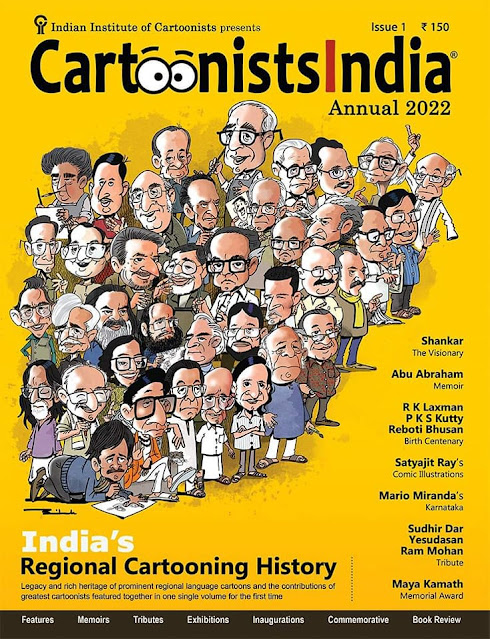
CartoonistsIndia Annual published by Indian Institute of Cartoonists (2022)

www.cartoonistsindia.org It was a great honour when IIC gave me the big responsibility to be the Editor of their first Annual CartoonistsInd...